
Interview with Jessica Hanna
Katie Lindsay, Artistic Director of Big Little Theater Company, sat down with Jessica Hanna, the 2026 Recipient of the Director-Driven Production Grant, to talk process, collaboration, and her directorial vision for O: A Rhapsody in Divorce by Jami Brandli. This conversation has been edited for length.
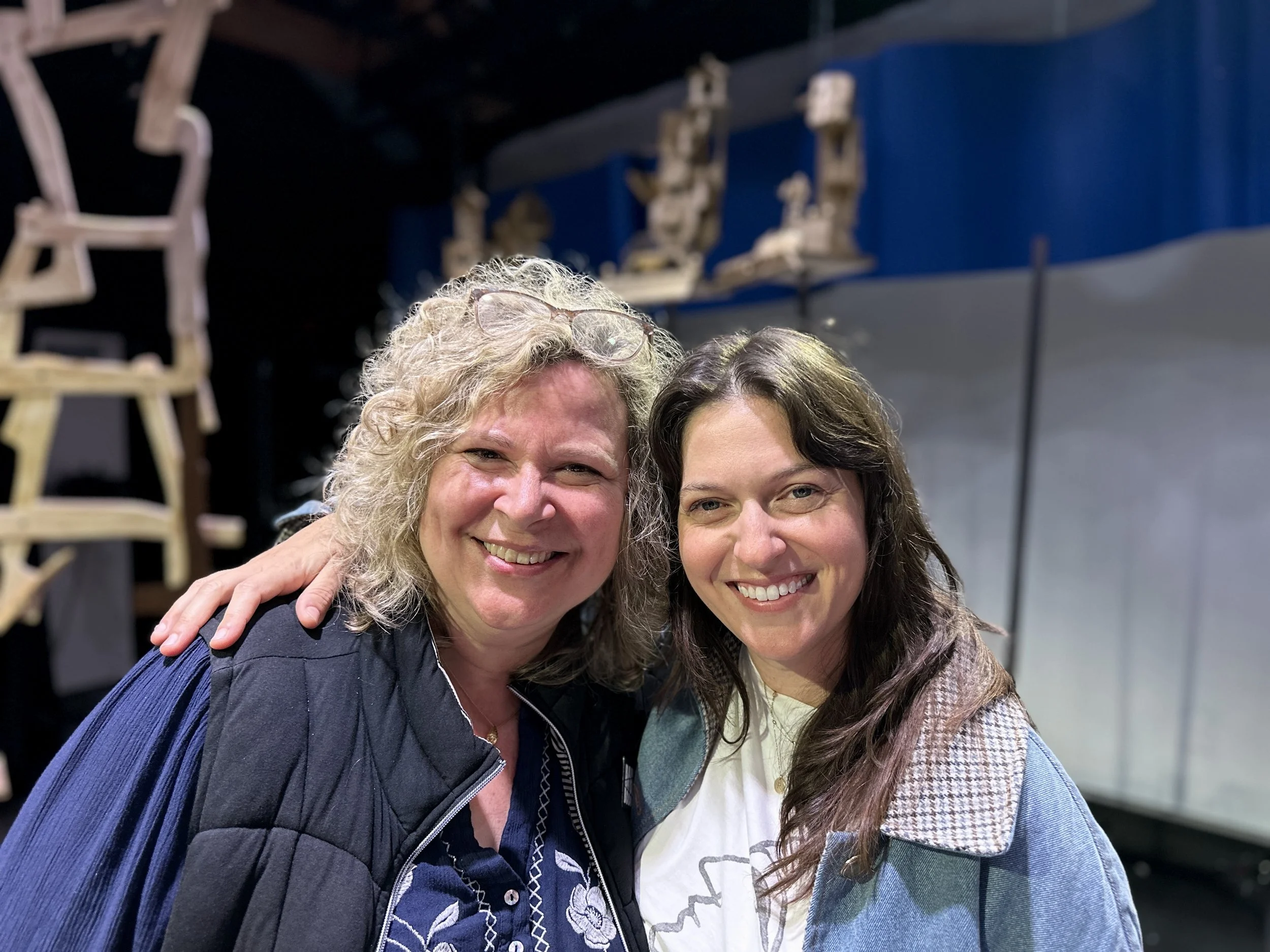
Jessica Hanna & Katie Lindsay at the table read for O: A Rhapsody in Divorce.
Katie: Tell me the origin story of your collaboration with Jami Brandli on O: A Rhapsody in Divorce.
Jessica: Jami and I met in 2014 when I was an actor (I know! It was the last full play I’ve been in as an actor) Jami and I really enjoyed working with each other and became friends through our colleagueship. Supporting each other and our work however we could.
Both Jami and my lives shifted 10 years ago when each of our marriages ended and we both were couch/apartment hopping as we figured out the next chapters of our lives. We spent time together talking through how to grow and change both in our personal lives and in our theatre making. Late one night in that period, Jami texted me, “What about a female Odysseus?” I texted an immediate, “YES PLEASE!” I have a long love of the Odyssey for many reasons, one of the earliest being that I grew up in Ithaca, NY and had always loved that the main point of the Odyssey was to get back home to Ithaka. But at the time Jami said it, I was definitely in the throes of figuring out where and what Home was, now that my life had shifted.
Jami and I talked about the different expectations for women in a separation or divorce situations and how home is so often defined around a woman or the woman “stays” at home and rebuilds from there, so what was home for us as we bounced around Los Angeles. We would talk about it on and off and then in 2018 Jami decided to go for it and write the play as part of the Playwrights Union write a play in a month challenge. Which she did! And part of that challenge is that they give readings to the plays that are created. Jami asked me to direct that first reading. And Donna Simone Johnson was in that original reading, playing Woman. It’s amazing that it has worked out that they are in town and available to play the part in this production!
There was a moment where it was going to be part of the 2020 season at Sacred Fools, but…as we all know that season never happened. I have been the director in two other workshops of the piece, the Inkwell workshop in 2022 and the Outside In workshop in 2024.
Katie: What’s the journey been like shepherding the play from development to production?
Jessica: It has been an absolute joy growing this play with Jami. So much of the play that she originally wrote in that month-long challenge is still in the play. Dare I say that, like Athena, much of this play emerged fully formed from Jami’s head. There have been changes through the workshops for sure, but mostly additions and refining, no major changes of order or huge edits. Jami will listen to ideas and notes and then be very honest about what works or doesn’t for her, so I know I can be totally honest and up front with her. It makes for great conversation that can go very deep. During the workshops we’ve had fantastic actors and creative artists in the room contributing to the conversation as well. Jami was up for some of my more non-traditional development ideas - like having three totally different casts read the play over the course of a week. So Jami could hear when certain lines were hitting a certain way coming through different folks - like, say a joke isn’t landing said by three different actors, then we need to look at that joke and work on the language. It gives the playwright useful feedback quickly. So that part of development has been really exciting and useful and we’re both incredibly grateful to all the actors that have been in the room with us and this play over the years, they are forever in the DNA of the play. And now the joy of the last six months has been putting together this fantastic design & production team to make the work three dimensional and gorgeous. I am so excited to be working with this team. I have a lot of history with most of the team and we are all very excited to be getting to create together again. All of the designers are collaborative and I can’t wait to get to tech when we’re all making in the room together, each of them bringing their genius elements and building the world that will uplift this story in ways Jami and I could never dream of. I love tech!
“Jami was up for some of my more non-traditional development ideas - like having three totally different casts read the play over the course of a week. So Jami could hear when certain lines were hitting a certain way coming through different folks - like, say a joke isn’t landing said by three different actors, then we need to look at that joke and work on the language. It gives the playwright useful feedback quickly. ”
Given your long history with this play, can you identify your fingerprints in the play itself?
The play is Jami’s but there are elements of our early conversations about Home and women’s place and cultural expectation that I can hear in the play. I know there are some elements that have been added during workshops that came from the questions I was asking or my suggesting the need for something new to happen - the Siren Song of Hope, when the women try to convince her that her husband wants to fix things, came from the conversations during a workshop.There are other elements of my own story that are in the play, but I don’t want to take any credit for Jami’s work. She’s created something out of many stories both true and mythical through her brilliant imagination and on to the page.
I can say that there is a physical gesture that is written in the script that comes directly from me describing how one of my favorite teachers, Ellen Lauren, reminded me where “Home” was. I don’t want to say too much more than that because I don’t want to give the gesture away. But mad props to Ellen for that gesture, I literally do it sometimes to remind myself that I am my Home.
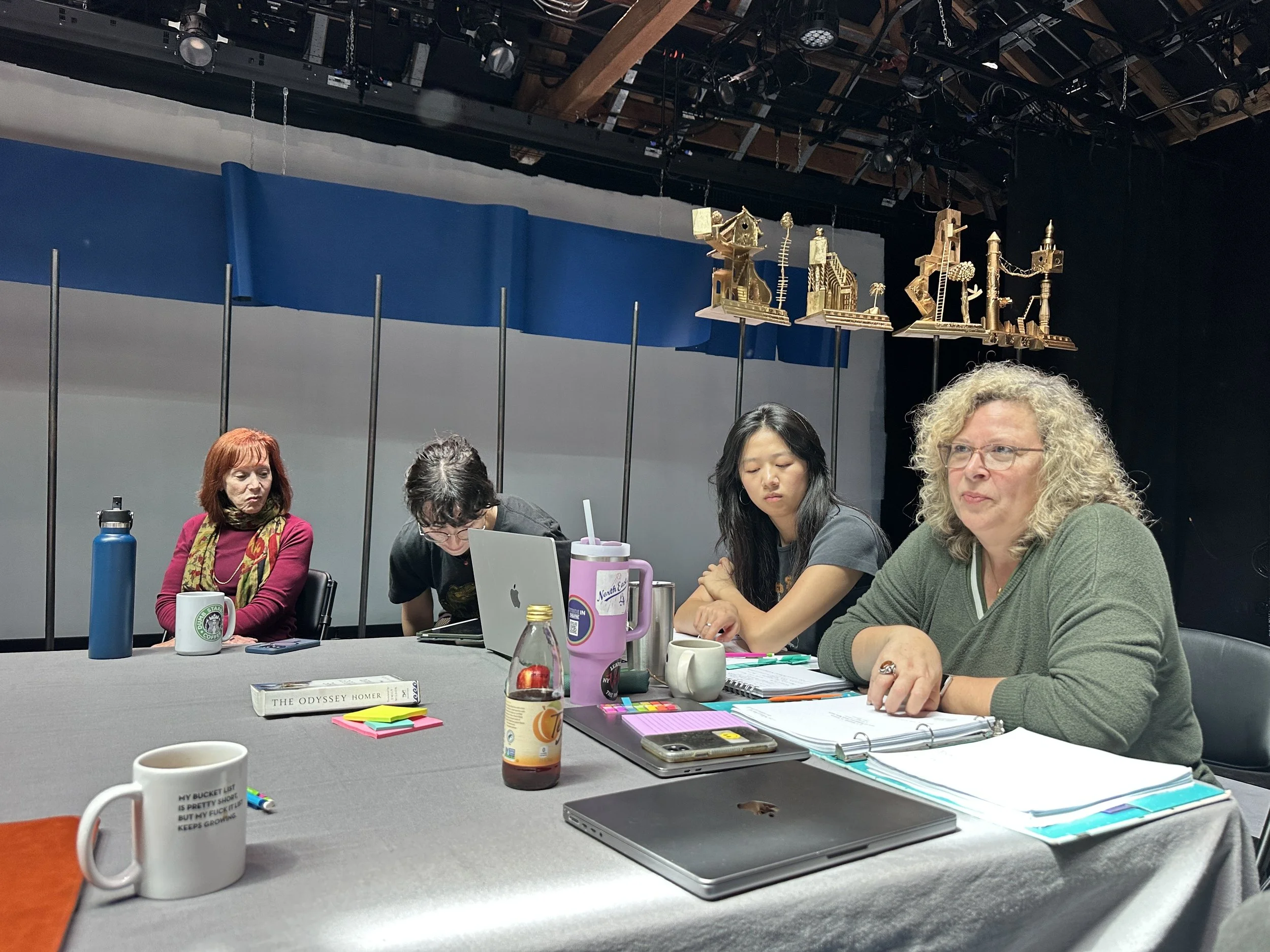
Jessica during tablework for O: A Rhapsody in Divorce.
Why does this play speak to you?
Well, there’s the obvious that it is representative of some of the happenings in my own life. And also because of the conversation of what or how a person has to find their own path and that the expectations or norms, if believed in, make for stormy seas that are no fun to navigate. As soon as I can let go of what I thought life was supposed to be, then I can embrace what life actually is and look forward to meeting life and excited about what life is offering.
I also resonate with the depiction of how quickly life can change, an unexpected event happens and suddenly the way that I look at the world has completely changed and feels surreal and takes time to adjust to. Change is the constant in life, but that doesn’t make rolling with those changes any easier. I think O’s story of figuring out that she has the answers, or at least the tools to find the answers, inside of her is a constant lesson for me. That line “No one is going to save you.” has a lot of meaning for me. I think I grew up believing that one person could make all the difference in whether I was happy or not…when the truth is that no one, outside of myself, is going to make me happy or save me from the hard moments of life. Some of this may be obvious to many, but I think each of us figures it out in our own time, if we have the privilege of growing older and learning more about ourselves and how we can thrive in the world.
And it’s about a woman figuring out how to grow and be strong and more herself every day. I want to see more stories about that. All the time. Give me the femme heroes journey any and every day!
How does your role as director differ when you’re in the development process vs a production process?
When I’m in a development process with a playwright I ask a lot of questions of the playwright, that’s the joy of working on a new play: The person who might actually have the answers is right there and I can ask them the why or the where did this come from or what are you hoping to show in this moment? Such a gift to have the playwright present.
When the play is still in the early creation process then I am wearing more of a dramaturgical hat in my questioning. I want to help the playwright find and craft the story they want to tell. A lot of that work is reflection back - here is what I hear, or see, from what’s on the page. Is that what they wanted to convey? Knowing, of course, that art is subjective and the playwright can take or leave my reflections or suggestions - it’s always their play. If I am making a space for the playwright to have a workshop then I am thinking about who the other artists in the room should be, who will be the most helpful to a playwright? Sometimes I bring in actors in workshops who aren’t the exact type that has been asked for in the script but that actor may have great insight or experience with new play development that could be really helpful to the playwright and their script.
When I get into production mode as a director it becomes more about solving the puzzle - oftentimes I think of directing a play as working on a 3D jigsaw puzzle: which piece goes where to make the picture the playwright intended? In the case of a new play, the picture may still be coming in to view at the same time as the puzzle pieces are coming together, so it’s much more fluid and some pieces will go in and then we realize they don’t quite fit because the picture has shifted, so I have to make choices to get to the picture the playwright wants and sometimes that means letting go of pieces that I really thought were right.
New play work is never an easy ride. I remind everyone involved that we have to be flexible and ready to make changes because those changes will improve the play. The playwright & the play are our guide stars. What is best for the play? Sometimes the most brilliant design idea turns out to not be what’s best for the play. It can be heartbreaking because sometimes months of work go into a moment that I have to cut. But if we’re all working toward a better play, then hopefully all involved know the hard choice is the best choice.
I also want to say that there is care for the actors in new play work that is different. Because we may make a change that seems like just a line cut to me and the playwright, but the actor may have based their whole character on that line and we have just taken away a piece of the emotional or psychological infrastructure they’ve been creating for themselves. Actors are so brave and that has to be acknowledged and supported, especially in new play development. I strive to make a supportive space and part of that is making sure there are conversations around changes so that actors don’t suddenly feel set adrift. Especially later in the process, say in the midst of previews, when changes could still be being made.